
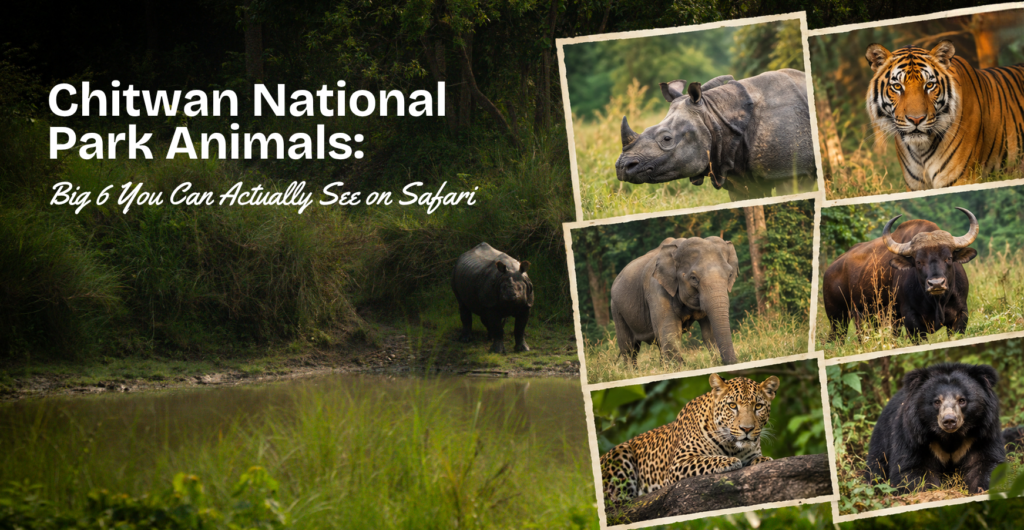
Wondering what wildlife awaits you in the lush jungles of Nepal’s first national park? Here’s your honest guide to the Big 6 animals of Chitwan and what to realistically expect on safari.
Chitwan National Park sits in the subtropical lowlands of southern Nepal, stretching across nearly 950 square kilometers of sal forests, grasslands, and river floodplains. Since being declared a UNESCO World Heritage Site in 1984, it has become one of Asia’s most reliable places to spot wild animals in their natural habitat: no zoo glass, no cages, just you, a guide, and the jungle.
But let’s be honest. Not every visitor walks out of Chitwan with the same experience. Some lucky travelers photograph a royal Bengal tiger from twenty feet away. Others spend five days hoping for just one glimpse of a rhino’s horn poking through the tall elephant grass.
So what are the Big 6 animals of Chitwan National Park? And more importantly what are your actual chances of seeing each one?
Let’s break it down.
The Big 6 Animals of Chitwan National Park
1. The Greater One-Horned Rhinoceros (Rhinoceros unicornis)
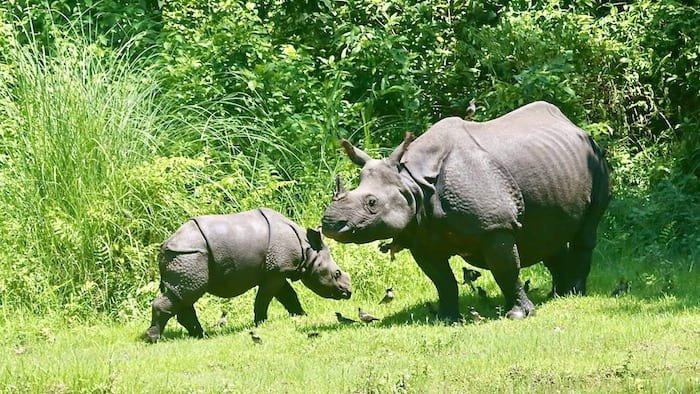
Your best bet on this list.
Chitwan holds one of the largest populations of greater one-horned rhinos on the planet — roughly 600+ individuals at last count. These prehistoric-looking creatures dominate the grasslands and are surprisingly easy to spot during the dry season when the vegetation thins out.
An adult rhino weighs around 2,000 kg and stands about six feet at the shoulder. Seeing one in the wild for the first time is genuinely jaw-dropping — they look like something that walked straight off the set of a prehistoric documentary.
Best safari season: October through March
Safari chance: Very high almost guaranteed on a jeep or elephant-back safari
Pro tip: During the dry months, rhinos regularly visit waterholes near Sauraha and Meghauli. Early morning safaris (starting around 6:00 AM) give you the best odds.
2. The Royal Bengal Tiger (Panthera tigris tigris)

The dream sighting is not guaranteed.
Let’s not sugarcoat it. Chitwan has an estimated 80–100 tigers, but the park’s dense sal forests and riverine vegetation make them incredibly hard to spot. They’re crepuscular, most active at dawn and dusk and they avoid human activity when they can.
That said, sighting a tiger here is far from impossible. With the right season, a skilled tracker, and a bit of patience, you might find pugmarks in the sand, alarm calls from langurs, or even the striped body of an adult moving through tall grass.
Best safari season: March through May (tigers come to water sources in the heat)
Safari chance: Low to moderate patience and luck matter more than anything
Honest take: Go to Chitwan hoping to see a rhino and dreaming about a tiger. If the tiger shows up, it will be the most unforgettable moment of your trip. If it doesn’t, you’ll still leave with incredible memories.
3. The Wild Elephant (Elephas maximus maximus)

Common but always thrilling.
Chitwan National Park has a healthy resident population of wild Asian elephants, plus several herds that migrate between India and Nepal. You’re very likely to spot them — especially around the Rapti and Narayani rivers where they come to drink and bathe.
Wild elephants here are bigger and more unpredictable than the domesticated ones you might encounter in tourist areas. A herd of 15–20 adults moving through the grasslands at close range is a powerful, humbling experience.
Best safari season: Year-round, but especially October through February
Safari chance: High — you’ll probably see them at least once
4. The Leopard (Panthera pardus)

Quiet, elusive, and harder than you think.
Leopards share Chitwan’s forests with tigers and are often overlooked in conversations about the Big 6. They’re solitary, nocturnal, and prefer rocky outcrops and dense undergrowth — exactly the kind of terrain that makes them nearly invisible during daytime safaris.
But they’re absolutely there. Camera traps set by the park’s conservation teams regularly capture them, and guides who work the southern grassland areas occasionally spot them at dusk near water sources.
Best safari season: October through February
Safari chance: Low this is the “bonus” sighting if it happens
5. The Sloth Bear (Melursus ursinus ursinus)
The underrated star of Chitwan.
Most visitors come to Chitwan thinking about rhinos and tigers, but the sloth bear is one of the park’s most fascinating residents. With shaggy black fur, a white V-shaped chest patch, and a long snout built for licking up termites, they look almost cartoonish up close.
Sloth bears are most active during the monsoon and early winter months. They feed on termite mounds and fallen fruits, and you’ll often find guides pointing out freshly clawed tree trunks — the telltale signs of a bear who was here just hours ago.
Best safari season: September through January
Safari chance: Moderate & more common than leopards, less predictable than rhinos
6. The Gharial (Gavialis gangeticus)
Stunning, strange, and critically endangered.
The gharial is a crocodilian with a long, narrow snout that looks like it belongs in another era. Chitwan’s Rapti River and Ganga Mukhi area are some of the best places in Nepal to see them basking on sandbanks during the winter months.
Unlike mugger crocodiles (which are also present in Chitwan), gharials are fish-eaters and pose virtually no threat to humans. Their elongated snout is packed with over 100 razor-sharp teeth, perfectly designed for catching fast-moving river fish.
Best safari season: November through February
Safari chance: High at designated river basking spots
Quick Comparison Table: Chitwan’s Big 6
| Animal | Safari Chance | Best Season | Where to Look |
| One-Horned Rhino | ⭐⭐⭐⭐⭐ (Very High) | Oct – Mar | Grasslands, waterholes |
| Royal Bengal Tiger | ⭐⭐ (Low-Moderate) | Mar – May | Forest trails, riverbanks |
| Wild Elephant | ⭐⭐⭐⭐ (High) | Oct – Feb | River corridors |
| Leopard | ⭐ (Low) | Oct – Feb | Rocky areas, southern grasslands |
| Sloth Bear | ⭐⭐⭐ (Moderate) | Sep – Jan | Termite-rich forest areas |
| Gharial | ⭐⭐⭐⭐ (High) | Nov – Feb | Rapti River sandbanks |
Beyond the Big 6: Other Animals You’ll Likely Spot
Chitwan isn’t just about the headline species. On a typical jeep safari, you may also encounter:
Spotted deer (chital): practically everywhere
Sambar deer: often near forest edges
Barking deer: heard more than seen
Wild boar: especially near water sources
Rhesus macaque and langur monkeys: active and vocal in the canopy
Garud, eagles, storks: incredible birdlife (Chitwan hosts over 540 bird species)
Monitor lizards: common near rivers
Cobra and python: occasionally spotted
Fun fact: Chitwan is recognized as an Important Bird Area by BirdLife International. Even if you’re not a birdwatcher, the diversity here will surprise you.
Safari Options in Chitwan National Park
Jeep Safari (Most Popular)
A covered or open-top jeep with a licensed guide and naturalist. Safaris typically last 3–4 hours and cover larger areas of the park than walking tours. Best for covering ground and spotting larger animals.
Elephant-Back Safari
A traditional way to explore the park, particularly useful in the tall elephant grass where visibility from a jeep can be limited. This practice is becoming more controversial and restricted, so confirm availability before booking.
Walking Safari
For the more adventurous traveler, walking safaris with an armed ranger offer an immersive experience. You’ll notice things a vehicle simply can’t: the sound of a sambar deer’s alarm call, the earthy smell of fresh pugmarks, the silence of a clearing where a tiger rested the night before.
Canoe Safari (Rapti River)
A dugout canoe paddle along the Rapti River at dawn or sunset. This is one of the best ways to see gharials, mugger crocodiles, and water birds like kingfishers, painted storks, and egret flocks.
Night Safari
Some lodges offer night drives just outside the park boundary (in buffer zones). This gives you a chance to see nocturnal species like the fishing cat, jungle cat, pangolin, and civets though big cats remain elusive.
When Is the Best Time to Visit Chitwan National Park?
This depends on what you want to see and how you feel about weather:
Dry Season (October – March): Best overall for visibility and comfort. Vegetation thins out, animals congregate at water sources, and daytime temperatures are pleasant. This is the peak tourist season.
Hot Season (April – May): Hotter and more humid, but excellent for tiger sightings as animals come to rivers and waterholes to cool off.
Monsoon Season (June – September): Many lodges and safari operators close during heavy rains (especially July–August). The park becomes lush and green, and some roads are impassable. Birdwatching can actually be great during the monsoon, but most tourists skip these months entirely.
Tips for Maximizing Your Safari in Chitwan
- Hire an experienced naturalist. The guide makes all the difference. A good guide reads animal behavior, understands seasonal patterns, and knows exactly which trail to follow based on pugmarks and alarm calls from other animals.
- Start early. Morning safaris (6:00 AM) and late afternoon drives (3:30 PM) offer the best chances. Animals are most active when temperatures are cool.
- Be quiet. It sounds obvious, but many safari groups talk constantly. Animals in Chitwan are wary of humans. Silence increases your odds of a close encounter significantly.
- Bring binoculars. A decent pair (8×42 or 10×42) transforms the experience. You’ll spot things far ahead of what the naked eye catches: a rhino behind grass, a bear on a ridge, a leopard resting in a tree.
- Wear neutral colors. Khaki, olive, and brown. Avoid bright red, white, or anything that stands out against the forest palette.
- Don’t chase perfection. Chitwan is not an African safari where animals are constantly visible on open plains. The jungle rewards patience. Sometimes the best safari moment is a quiet one watching mist lift off the river at dawn, hearing a peacock’s call echo through the sal forest, or realizing you’re completely alone in a wild place.
Final Thoughts
Chitwan National Park doesn’t promise perfection, it promises authenticity. You won’t see animals herded across open savannah like you might in the Serengeti. What you’ll find instead is a living, breathing subtropical forest that has survived centuries of human pressure and still shelters some of Asia’s most iconic species.
The one-horned rhino will probably make your trip. The tiger might. And if you’re fortunate enough to hear the distant roar of a Bengal tiger echo through the sal forest at midnight — from your lodge bed, no less you’ll understand why people keep coming back to this corner of Nepal.
Plan honestly. Prepare thoroughly. Leave with your expectations set to the jungle’s rhythm, and Chitwan will reward you.
Frequently Asked Questions (FAQs)
What is the best time of year to see a tiger in Chitwan National Park?
March through May is considered the best window for tiger sightings. The heat forces tigers to visit rivers and waterholes during daylight hours, which coincides with typical safari schedules. February can also be productive as the dry season deepens.
Can you see a tiger on safari in Chitwan National Park?
Yes. But temper your expectations. Chitwan has a healthy tiger population (80–100 individuals), but sighting one in the wild remains largely a matter of luck, season, and guide expertise. A well-informed guide will read pugmarks and follow alarm calls from monkeys and deer, which significantly improves your odds, but no guide can guarantee a tiger sighting.
Is Chitwan National Park safe for tourists?
Yes, Chitwan is considered safe for international visitors. The park has armed rangers who accompany safari groups, and lodges maintain high safety standards. The main risks are related to animal encounters if safety protocols aren’t followed (which is why you should always stay in the vehicle during jeep safaris and never approach animals on foot without a guide).
How do I reach Chitwan National Park?
The most common route is by bus or private car from Kathmandu (approximately 5–6 hours by road) or from Pokhara (approximately 4–5 hours by road). Direct flights from Kathmandu to Bharatpur Airport (the nearest airport to Chitwan) take about 30 minutes, and many visitors fly in to save time. The main tourist area is Sauraha, located just outside the park’s eastern boundary.